Select a different country or region to see specific content for your location.
Sustainable products
Increasing sustainability in our customers’ applications
Increasing sustainability in our customers’ applications
As a global processor of plastics, we are aware of our special responsibility. Based on our product families Röchling-BioBoom® and Röchling-ReLoop®, we are continuously expanding our portfolio of bioplastics and high-quality recycled materials. Likewise, our fossil-based plastics contribute to resource conservation in many of our customers' applications during use. Our goal: reduce the environmental footprint and increase sustainability in our customers’ industries.

For our Röchling-BioBoom® product family of bioplastics, we extract bio-based raw materials and conserve fossil resources. The Röchling-BioBoom® range includes bio-based plastics and mass-balanced bioplastics containing varying proportions of bio-based raw materials.

Our Röchling-ReLoop® product family for high-quality recycled materials conserves valuable resources and closes material cycles. The Röchling-ReLoop® portfolio comprises post-consumer and post-industrial recycled products with varying proportions of recycled material.
Reducing the use of fossil-based raw materials

With Röchling-ReLoop®, you can promote the use of high-quality recycled materials as an alternative to primary fossil raw materials.
Promoting bio-based raw materials

With Röchling-BioBoom® you foster the use of bio-based raw materials.
Strengthening the circular economy

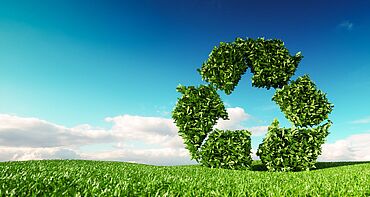
Strengthening the circular economy is one of the most important tasks in the plastics industry. Increase the use of secondary raw materials by using our sustainable products.
Reducing the environmental footprint

By using recyclates and bio-based raw materials, we want to contribute to reducing the ecological footprint in our customers' applications. LCAs are already available for many of our materials.
Create competitive advantage

With Röchling-ReLoop®, we support sustainability in our customers’ industries through the use of high-quality recycled materials and create competitive advantages.
Röchling-BioBoom® materials
Röchling-ReLoop® materials

Lifecycle
Sustainability is not only a question of the raw material used, but also depends on factors such as use in the customer’s application, service life and end-of-life options. Every product consumes resources and has an environmental impact. Considering these factors over the life cycle is crucial for assessing how sustainable a product is. Engineering and sustainability therefore have to be considered in conjunction.This applies to any product made of any material. In this way, ecological, technical and economic advantages can be combined.